
How Do Your Headphones Work?
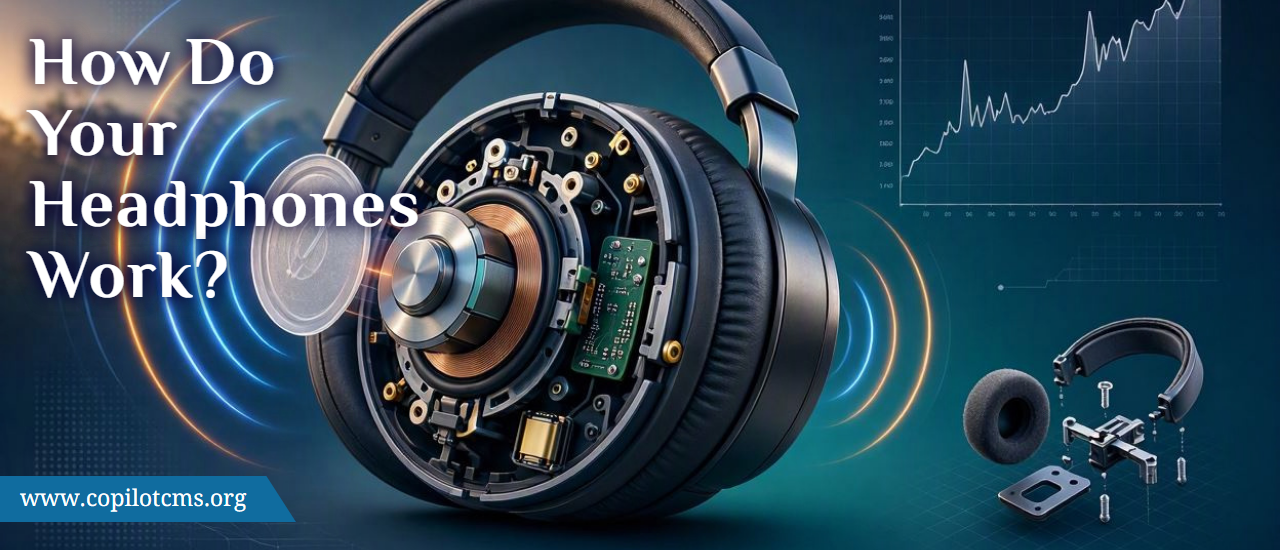
Put on a pair of headphones, press play, and suddenly a tiny device next to your ears is turning electrical signals into music, voices, and sound. But how can something so small actually reproduce a whole song?
The Basic Idea: Headphones Turn Electricity Into Sound
At their simplest, headphones are devices that convert an electrical signal into vibrations that your ears can hear as sound.
Your phone, computer, or other audio device stores or receives music as digital information. Before your headphones can play it, that information is turned into an electrical audio signal. The headphones then use that signal to move a tiny component back and forth extremely quickly.
That movement pushes and pulls the air around it, creating tiny changes in air pressure. Those pressure changes travel through the air into your ears, where your brain interprets them as sound.
So the basic chain looks like this:
Digital music → electrical signal → moving headphone driver → vibrating air → your ears → your brain
What Is a Headphone Driver?
The most important part inside most headphones is called the driver. You can think of the driver as the headphone's tiny loudspeaker.
Every pair of headphones has at least one driver for each ear. Larger headphones may have relatively large drivers, while earbuds contain extremely small ones.
The driver's job is simple: move in a very controlled way to reproduce the changing electrical signal it receives.
Why Does the Driver Need to Move?
Sound is essentially a pattern of vibrations traveling through a material such as air.
When a person speaks, for example, their vocal cords vibrate. Those vibrations cause nearby air molecules to move back and forth, creating waves of changing air pressure. Your eardrum detects those changes, and your brain turns them into what you recognize as speech.
A headphone driver does something remarkably similar. Instead of vocal cords producing the vibrations, the driver's thin diaphragm moves back and forth.
How Does a Driver Actually Move?
A common type of headphone driver uses three important parts:
- A magnet that produces a magnetic field.
- A voice coil, which is a small coil of wire that carries the electrical audio signal.
- A diaphragm, a thin material that moves when the voice coil moves.
When the audio signal flows through the voice coil, it interacts with the magnetic field. This creates a force that makes the coil move.
The coil is attached to the diaphragm, so the diaphragm moves too. As the diaphragm moves forward and backward, it pushes and pulls the surrounding air.
Those movements become the sound you hear.
A Real-World Version: Imagine a Tiny Drum
Imagine holding a very small drum near your ear. If you push the drum skin forward and pull it backward repeatedly, it will disturb the air around it.
Now imagine that instead of your hand moving the drum skin, an incredibly precise mechanism controls it thousands of times per second.
That is roughly what a headphone driver is doing.
The driver is not literally playing a tiny recording of a song. It is creating the physical air-pressure pattern that represents the song.
How Can Headphones Reproduce Different Sounds?
A song contains many different sounds at the same time: a singer's voice, drums, guitar, piano, bass, and perhaps dozens of other instruments.
The headphone driver combines all of these sounds into one rapidly changing movement pattern.
For example, a deep bass note causes relatively large, slow movements compared with the tiny, rapid movements associated with high-frequency sounds.
The driver must reproduce these changes accurately enough that your ears receive a pattern similar to the original audio signal.
Low Frequencies: Bass
Low-frequency sounds correspond to slower vibrations. Bass drums and deep musical notes are examples.
To reproduce them, the headphone driver moves back and forth at relatively low frequencies, often with noticeable physical movement.
High Frequencies: Treble
High-frequency sounds correspond to much faster vibrations. Cymbals, certain musical instruments, and the higher parts of human speech contain many high-frequency components.
The driver has to make much smaller and faster movements to reproduce these sounds.
What Does Frequency Mean?
Frequency describes how many times something repeats each second.
Frequency is measured in hertz (Hz). One hertz means one cycle per second.
If something vibrates at 100 Hz, it completes about 100 cycles every second. If it vibrates at 1,000 Hz, it completes about 1,000 cycles every second.
This is one reason frequency is important in audio: different frequencies are perceived as different pitches.
In general:
- Lower frequencies sound deeper.
- Higher frequencies sound higher or brighter.
What Is Volume Then?
Frequency mainly affects pitch, while the size of the vibration is closely related to how loud the sound is.
Imagine moving your hand gently through the air. Then imagine moving it much farther back and forth. The larger movement disturbs more air.
A headphone driver works in a similar way. A stronger signal can produce greater movement of the diaphragm, resulting in greater sound pressure at your ear.
This is why increasing the volume does not simply make the headphone "play faster." It generally increases the strength or amplitude of the audio signal.
How Does Stereo Sound Work?
Most modern headphones have separate audio channels for the left and right ears.
The left driver receives the left channel, while the right driver receives the right channel.
This allows audio engineers to create the impression that different sounds are coming from different positions.
For example, a recording might place a guitar slightly toward the left and another instrument toward the right. Your brain combines the information from both ears and interprets these differences as a sense of space.
Why Two Ears Matter
Your brain is remarkably good at figuring out where sounds are coming from because the sound reaching each ear is slightly different.
Headphones take advantage of this ability by giving each ear carefully controlled audio information.
This is also why stereo headphones can make music, movies, and games feel much more spacious than a single speaker.
How Do Wired Headphones Get the Audio?
Traditional wired headphones receive their audio through an electrical connection.
A cable carries the changing electrical audio signal from the phone, computer, amplifier, or other device to the headphone drivers.
The electrical signal continuously changes according to the sound that needs to be reproduced.
The headphone's driver responds to those changes by moving its diaphragm accordingly.
In a simplified form:
Audio device → cable → electrical signal → driver → air vibrations → your ears
What About Wireless Headphones?
Wireless headphones do essentially the same final job, but they have to receive the audio without a physical cable carrying the signal.
Bluetooth is commonly used for this.
When you play music on a phone, the audio data is prepared for wireless transmission. The phone sends that information over the wireless connection to the headphones.
The headphones receive the data, process it, convert it into an electrical audio signal, and send that signal to the drivers.
The simplified chain becomes:
Phone → wireless transmission → headphone electronics → electrical signal → driver → sound
Why Do Wireless Headphones Need Batteries?
A wired headphone can receive much of the necessary electrical signal and power through its connection to the audio device. Wireless headphones do not have that luxury.
They contain their own electronics, so they need their own source of power.
A typical wireless headphone or earbud may contain:
- A battery.
- A wireless communication chip.
- A processor or audio-processing circuitry.
- Digital-to-analog conversion circuitry.
- Amplification circuitry.
- One or more headphone drivers.
- Microphones for calls, noise cancellation, or other features.
The battery supplies the energy needed to operate these components.
What Is a Digital-to-Analog Converter?
Modern music is usually stored and processed digitally. Computers do not naturally work with the continuous physical movement needed to create sound, so the digital information must eventually be converted into an electrical representation of the sound.
This is where a digital-to-analog converter, commonly called a DAC, comes in.
A DAC takes digital audio information and converts it into a continuously changing electrical signal that audio hardware can use.
A Simple Analogy
Imagine someone gives you a recipe written entirely as numbers and codes. You understand the instructions, but a cook needs those instructions translated into physical actions.
A DAC performs a somewhat similar translation: it helps turn digital instructions representing audio into an electrical signal that can ultimately control a physical speaker driver.
The exact electronics are more complicated, but the important idea for a beginner is simply:
Digital information needs to be converted into a form that physical audio hardware can use.
What Does an Amplifier Do?
The electrical signal coming from an audio source may not have enough power to move a headphone driver effectively.
An amplifier provides the driver with the electrical power it needs.
Think of the audio signal as instructions telling a worker exactly how to move a heavy object. The instructions contain the pattern, but the worker still needs enough strength to perform the movement.
An amplifier supplies that additional electrical power while preserving the shape of the audio signal as accurately as possible.
Wireless headphones usually contain their own small amplifier. Some wired headphones can also benefit from a dedicated headphone amplifier, particularly when they require more power than a typical phone or computer output can provide.
Why Do Some Headphones Sound Different?
If headphones are all converting electrical signals into vibrations, why don't all headphones sound exactly the same?
Because reproducing sound accurately is surprisingly difficult.
Different headphones can use different:
- Driver designs.
- Driver sizes.
- Materials.
- Electrical components.
- Audio tuning.
- Earcup shapes.
- Ear tips and seals.
- Noise-control systems.
Even the shape of the space between the driver and your ear can affect the sound you perceive.
Why Do Earbuds Need a Good Seal?
If you use in-ear earbuds, the fit of the ear tip can make a surprisingly large difference.
Imagine trying to inflate a bicycle tire while leaving a large hole in the tube. Air would escape instead of building pressure effectively.
An earbud's seal works somewhat similarly. A good seal helps control the air between the driver and your eardrum.
A poor seal can allow outside air to enter and escape, often making bass sound noticeably weaker.
This is one reason two people can use the same earbuds and think they sound slightly different: their ear shapes and the fit of the earbuds may not be identical.
How Do Headphones Cancel Outside Noise?
Some headphones have active noise cancellation, or ANC.
ANC uses microphones to listen to sounds around you. The headphone's electronics then generate another sound signal designed to reduce the unwanted noise reaching your ears.
The Simple Version
Imagine waves moving across the surface of a swimming pool. If you could create another wave at precisely the right time and position, the two waves could partially cancel each other.
Sound waves can behave similarly.
Noise-cancelling headphones detect certain outside sounds and produce an opposing audio signal. When the two sound waves meet, they can partially cancel each other, reducing the amount of unwanted sound you hear.
ANC is particularly useful for relatively continuous sounds such as airplane engines, air conditioners, fans, and other steady background noise.
It is generally more difficult to completely cancel sudden, unpredictable sounds such as someone snapping their fingers nearby.
What Is Passive Noise Isolation?
Not all noise reduction requires electronics.
Passive noise isolation happens when the physical design of the headphones blocks or reduces outside sound.
Over-ear headphones can cover your ears with cushions. In-ear earbuds can form a seal inside the ear canal.
This is similar to putting your hands over your ears. No electronics are required; the physical barrier simply reduces the amount of sound reaching your ears.
Many headphones use both passive isolation and active noise cancellation.
How Do Headphones Know When You Put Them On?
Some modern headphones have sensors that can detect whether they are being worn.
Depending on the design, sensors may detect things such as proximity, skin contact, changes in light, or other physical conditions.
This allows features such as automatic pause and play.
For example, when you remove an earbud, its sensors may detect the change and tell the headphones to pause the music. When you put it back in, playback can resume.
How Does the Microphone in Headphones Work?
Headphones used for phone calls and gaming often contain microphones as well as speakers.
A microphone essentially performs the reverse process of a speaker.
A speaker takes an electrical signal and creates physical vibrations in the air. A microphone detects changes in air pressure caused by sounds and converts them into an electrical signal.
So during a phone call, the process can look like this:
Your voice → air vibrations → microphone → electrical/digital signal → phone → network → other person's device
The other person's headphones then convert the received audio back into physical air vibrations.
Why Can Headphones Make Music Sound Like It's Coming From Behind You?
Modern audio can manipulate tiny differences between the signals reaching your left and right ears.
For example, a sound can be made slightly louder in one ear, arrive at one ear slightly earlier, or have other characteristics changed.
Your brain uses such differences as clues about where sounds are located.
Advanced systems take this much further. Spatial audio and similar technologies can process sound in ways designed to create a three-dimensional impression, making certain sounds appear to come from particular directions.
Why Do Headphones Sometimes Have a Delay?
You may occasionally notice that Bluetooth audio seems slightly behind what is happening on screen.
This can happen because wireless audio has to go through several steps:
- The original audio is processed.
- The audio is prepared for wireless transmission.
- The data travels wirelessly to the headphones.
- The headphones receive and process the data.
- The audio is converted into an electrical signal.
- The driver produces the sound.
All of those steps take a small amount of time.
Modern wireless systems can reduce this delay significantly, and some devices offer special low-latency modes for gaming or video.
Why Do Headphones Sometimes Stop Working?
Because headphones contain several different parts, a problem in any one of them can cause trouble.
If There Is No Sound
Check the simplest possibilities first:
- Make sure the volume is turned up.
- Check that the correct audio output device is selected.
- For wireless headphones, make sure they are connected.
- Check whether the headphones have enough battery power.
- Try another application or audio source.
- Try the headphones with another device.
If the headphones work on another device, the problem may be with the original device or its settings rather than the headphones themselves.
If Only One Side Works
With wired headphones, a damaged cable or connector can cause one channel to stop working.
With wireless earbuds, the problem might instead involve charging, pairing, software, or the individual earbud.
Cleaning the charging contacts and checking the device's Bluetooth connection can sometimes solve the problem.
If the Sound Is Distorted
Distortion can have several causes, including excessive volume, damaged hardware, poor connections, or problems with the audio source.
Try lowering the volume and testing another recording. If the distortion remains across multiple devices and recordings, the headphones themselves may have a hardware problem.
Why This Matters: Headphones Are Tiny Pieces of Engineering
Headphones may look simple from the outside, but they combine several areas of technology in an extremely small space.
A modern pair of wireless earbuds can contain miniature speakers, microphones, batteries, processors, wireless radios, sensors, amplifiers, charging circuits, and software.
All of these components work together so that you can tap a screen and hear a song almost instantly.
Understanding this also explains why headphones can have very different prices and capabilities. A basic pair may primarily contain drivers and a cable, while advanced wireless headphones can contain a surprisingly sophisticated collection of electronics.
Headphones in One Simple Picture
You can think of the whole process as a translation chain:
Music data tells the device what sound to produce.
↓
Audio electronics turn that information into an electrical signal.
↓
The amplifier provides the electrical power needed to drive the speaker.
↓
The driver converts the electrical signal into physical movement.
↓
The moving diaphragm pushes and pulls the air.
↓
Your ears detect the changing air pressure.
↓
Your brain interprets those signals as music, speech, or other sounds.
The Takeaway
Headphones work by turning electrical audio signals into tiny, precisely controlled physical movements. A component called a driver moves a diaphragm back and forth, creating changes in air pressure that your ears detect as sound.
Wired headphones receive their signals through a cable, while wireless headphones receive digital audio over a wireless connection and use their own electronics to process it. Features such as microphones, active noise cancellation, sensors, and spatial audio add more technology around the same basic idea.
So the next time you put on a pair of headphones, remember what is happening just millimeters from your ears: tiny pieces of metal, magnets, electronics, and a vibrating diaphragm are working together thousands of times per second to recreate the sound you wanted to hear.