
What Is an AI Model Made Of? A beginner's tour of parameters, training, and inference
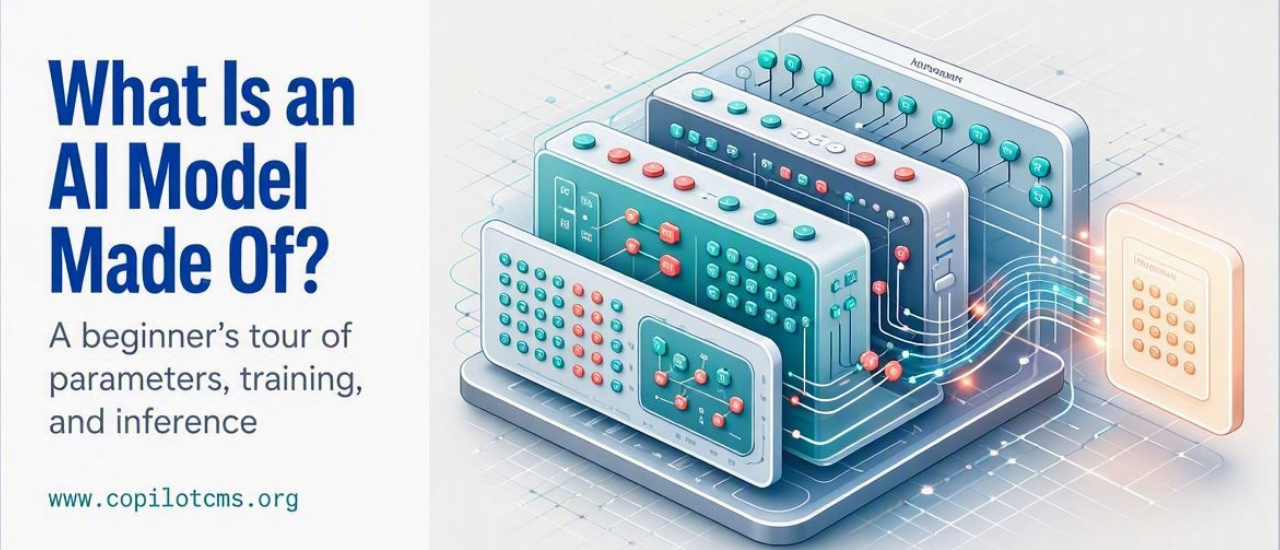
When you ask an AI a question and it produces an answer in seconds, it can feel almost magical. But underneath the conversation is something much more understandable: a huge collection of learned numbers, created through training and used during a process called inference.
The Simple Answer: An AI Model Is Mostly Numbers
At its most basic level, an AI model is a mathematical system containing a very large number of numerical values called parameters. These numbers help the model recognize patterns and make predictions.
That may sound surprisingly ordinary. There isn't a tiny person inside the computer reading your question, and there isn't a giant database containing a perfect answer to every possible question. Instead, the model has learned patterns from enormous amounts of training material and stores what it learned in the form of numerical values.
For a language model, those learned patterns can involve relationships between words, phrases, ideas, grammar, facts, writing styles, and many other aspects of language.
Real-World Version: Learning to Complete a Sentence
Imagine giving someone thousands of books and asking them to study how language works. After reading enough examples, they might become very good at predicting what word or phrase is likely to come next.
If you say:
"The sun rises in the..."
you probably expect "east".
You don't need to memorize every sentence ever written to make that prediction. You have learned patterns from experience.
An AI language model works in a somewhat similar way, although the actual mathematics is vastly more complicated. During training, it processes enormous numbers of examples and adjusts its internal numerical values so that its predictions become better.
The important idea is this: the model learns patterns rather than simply storing a collection of ready-made answers.
What Are Parameters?
Parameters are numbers inside an AI model that are adjusted during training. They are one of the main ingredients that determine what the model has learned and how it behaves.
You can think of parameters as thousands, millions, or billions of tiny adjustable controls.
Imagine an enormous sound-mixing console with countless knobs. One knob might affect one aspect of the sound, while another affects something else. You wouldn't normally know exactly what each individual knob does, but together they determine the final result.
AI parameters are somewhat like those knobs. During training, the system repeatedly adjusts them until the model becomes better at its task.
Why Are There So Many Parameters?
Human language is complicated. A useful language model needs to recognize many different relationships.
For example, it may need to learn that:
- "cat" and "kitten" are related concepts.
- "Paris" is associated with France.
- "running" and "ran" are different forms of a related word.
- A question usually expects some kind of answer.
- The meaning of a word can change depending on the surrounding words.
- A programming question requires a different style of response from a casual conversation.
No single parameter necessarily represents one complete fact or concept. Instead, information is distributed across many parts of the model.
Parameters Are Not the Same as Stored Facts
This is an important distinction for beginners.
If an AI model can answer "What is the capital of France?" with "Paris," it does not necessarily mean there is a little database entry inside the model that simply says:
France = Paris
Some information can be represented in ways that behave more like learned patterns spread throughout the model.
A useful analogy is learning someone's face. Your brain doesn't necessarily contain a single tiny file labeled "John's face." Instead, recognition depends on many interconnected patterns involving shapes, proportions, colors, and other features.
AI models can similarly represent information through complicated patterns distributed across their parameters.
Where Do the Parameters Come From?
This brings us to training.
Parameters don't begin as a complete collection of useful knowledge. Training is the process through which the model gradually adjusts them.
One simplified way to imagine the process is:
- The model receives an example.
- It makes a prediction.
- The prediction is compared with the expected result.
- The system calculates how wrong the prediction was.
- The model adjusts some of its parameters.
- The process is repeated many, many times.
Each individual adjustment may be tiny. But after enormous numbers of training steps, those small changes can produce a model capable of recognizing remarkably complex patterns.
What Does an AI Actually Learn During Training?
For a language model, training can teach the system statistical relationships within language and other patterns present in its training material.
For example, the model may gradually become better at recognizing:
- grammar and sentence structure
- relationships between words
- common phrases and expressions
- patterns in explanations and conversations
- relationships between concepts
- different styles of writing
- patterns found in programming languages and code
It is important not to imagine this as a human sitting down and explicitly teaching every individual rule. Much of the learning happens automatically as the training process adjusts the model's parameters.
The Training Process: A Simple Example
Suppose a model sees this sentence:
"The dog chased the..."
The model might predict several possible next words. Perhaps "ball" receives a high probability, while many unrelated words receive lower probabilities.
If the training example says the next word should be "cat," the model's prediction was not quite right. The training system calculates an error and uses that information to adjust the model.
Then it tries again with another example.
One example does almost nothing by itself. But repeat the process over an enormous collection of training examples, with sophisticated mathematics and optimization techniques, and the model can gradually become much better at predicting patterns.
What Is a Neural Network?
Many modern AI models are built using a type of mathematical structure called a neural network.
The name comes from a loose analogy with biological brains. Artificial neural networks are not miniature human brains, however. They are mathematical systems made from layers of computational operations.
You can picture a neural network as a huge factory assembly line.
Information enters at one end. It passes through many stages of mathematical processing, with each stage transforming the information in some way. Eventually, a result comes out the other end.
The parameters are part of those mathematical operations. They help determine how information is transformed as it moves through the network.
What Are Layers?
Neural networks are commonly organized into layers. Each layer performs mathematical operations on information and passes the result to another part of the network.
In a very simplified analogy, imagine a team of workers processing a package:
- The first worker examines the package.
- The next worker extracts useful information.
- Another worker compares it with other patterns.
- Another combines different pieces of information.
- The final worker helps produce the result.
A modern AI model is vastly more complicated than this analogy, but the general idea is useful: the model transforms information through many stages rather than jumping directly from a question to an answer.
What Makes Modern AI Models So Large?
Modern models can contain enormous numbers of parameters. More parameters can give a model more capacity to represent complicated patterns, although simply increasing the number of parameters does not automatically make a model better.
Model quality also depends on factors such as the training data, architecture, training methods, computing resources, and additional processes used to improve the model.
Think of parameters as the size of a workshop. A larger workshop gives you room for more tools and equipment, but simply having a bigger building doesn't guarantee that the work produced inside will be better.
What Is Training Data?
Training data is the material used to teach a model during its training process.
Depending on the type of AI system, training data might include text, images, audio, video, code, numerical information, or other kinds of data.
For a language model, training material can contain large amounts of text. The model processes this material to learn patterns that help it perform language-related tasks.
The exact sources and composition of training data vary from one AI system to another. Not every model is trained in the same way or on the same material.
Training Doesn't Mean the Model Reads Like a Human
When we say that an AI model "reads" text during training, this is a convenient simplification.
A computer doesn't experience a book in the same way a human reader does. Text must be converted into numerical representations that the model can process mathematically.
This is one reason why understanding AI requires separating everyday language from what is actually happening inside the computer.
What Are Tokens?
Before a language model can process text, the text is generally broken into pieces called tokens.
A token may correspond to a whole word, part of a word, punctuation, or another piece of text, depending on the tokenization system.
For example, a simple phrase such as:
"Hello, world!"
might be represented internally as several tokens rather than being treated as one indivisible object.
Those tokens are then converted into numerical representations that the model can work with.
From Words to Numbers
Computers are extremely good at manipulating numbers. They don't directly perform neural-network calculations on the meaning of the English word "cat" in the way a person thinks about the word.
Instead, language is transformed into numerical representations.
One important concept here is an embedding. An embedding is a numerical representation that can capture useful relationships between pieces of information.
As a simplified example, imagine placing words on a huge mathematical map. Words with related meanings may end up in related regions of that map.
This doesn't mean there is literally a two-dimensional map inside the AI. Real embeddings typically contain many numerical dimensions and are much harder to visualize.
Training vs. Inference
Two words are especially important when understanding how AI works: training and inference.
Training
Training is when the model's parameters are adjusted so the model learns useful patterns.
Think of it like studying for an exam. You encounter examples, make mistakes, receive feedback, and gradually improve your understanding.
Inference
Inference is what happens when the trained model is actually used.
When you type a question into an AI chatbot, the model processes your input using the parameters it already has and generates an output.
In the exam analogy, training is the studying. Inference is actually taking the exam using what you learned.
What Happens When You Ask an AI a Question?
Let's simplify the journey of a question such as:
"Why is the sky blue?"
- Your text is received by the AI system.
- The text is broken into tokens.
- The tokens are converted into numerical representations.
- The model processes those representations through its neural-network architecture.
- The model calculates probabilities for possible next tokens.
- A token is selected according to the model's generation process.
- The process repeats until the response is complete.
- The resulting tokens are converted back into text that you can read.
This entire process is called inference.
Does the AI Write the Entire Answer at Once?
Usually, it is more useful to think of a language model as generating a response step by step, token by token.
Imagine someone writing a sentence one word at a time. After writing one word, they consider what would make sense next. Then they continue.
A language model performs a mathematical version of this prediction process.
If the beginning of a sentence strongly suggests a particular continuation, that continuation may receive a high probability. Other possibilities may receive lower probabilities.
What Does "Probability" Mean Here?
Suppose you type:
"Peanut butter and..."
A language model might assign a relatively high probability to "jelly", while other words receive lower probabilities.
The model isn't necessarily thinking, "I personally prefer jelly." It is calculating numerical relationships based on patterns learned during training.
This is why language models can produce fluent sentences without having human-like thoughts or intentions.
Why Can AI Give Different Answers to the Same Question?
If a model is predicting possible next tokens, there can be multiple reasonable choices.
Imagine asking a person:
"Give me a word that describes the ocean."
They might say "vast," "blue," "deep," or "beautiful." Several answers can make sense.
AI generation can similarly involve choices among plausible possibilities. Settings and generation methods can influence how predictable or varied the output becomes.
Where Does the Model's "Knowledge" Live?
For a trained model, much of what it has learned is represented through its parameters and associated numerical structures.
However, this does not mean the model contains a perfectly organized encyclopedia inside it.
Its learned information is distributed throughout a complicated mathematical system. This is one reason a model can sometimes produce an answer that sounds convincing but is incorrect.
Why Can AI Make Mistakes?
One of the biggest beginner misunderstandings is assuming that an AI model works like a search engine or a traditional database.
A database can retrieve a stored record. A language model is primarily generating predictions based on learned patterns.
That difference matters.
A model can produce a sentence that looks perfectly reasonable even when the underlying claim is wrong. This behavior is commonly referred to as an AI hallucination.
The model's ability to produce fluent language does not guarantee that every statement it generates is factually correct.
Why Training Requires So Much Computing Power
Training a large AI model involves performing enormous numbers of mathematical calculations.
Imagine trying to adjust billions of tiny knobs while repeatedly checking whether the result is getting better. Doing this once would be difficult. Doing it over huge amounts of data and many training steps requires substantial computing resources.
This is why large-scale AI training can involve powerful processors, specialized AI accelerators, large amounts of memory, and significant amounts of electricity.
Why GPUs Are Often Used for AI
Graphics processing units, or GPUs, were originally designed for tasks such as rendering graphics. But they are also very good at performing many similar mathematical operations in parallel.
AI workloads contain enormous numbers of calculations that can often be performed simultaneously.
Think of the difference between asking one person to calculate thousands of small sums one after another and giving the same work to a large room full of calculators that can operate at the same time.
This is one reason GPUs and other specialized processors have become so important for modern AI.
Training Can Be Extremely Expensive
Large AI systems may require huge computing clusters, extensive datasets, engineering infrastructure, storage, networking, cooling, and electricity.
Training is also only part of the story. Once a model is available, running it for users requires computing resources too.
This leads to an important distinction:
- Training cost: the resources required to create or significantly improve the model.
- Inference cost: the resources required to run the trained model and generate responses.
Training Once Doesn't Mean the Model Never Changes
It is tempting to imagine that an AI model is trained once and then remains exactly the same forever.
In practice, AI systems can be updated or improved in different ways. Developers may train new versions, adjust the model, fine-tune it for particular tasks, change surrounding systems, or connect it to external information sources.
So when you use an AI product, the experience may involve more than one trained model working by itself.
What Is Fine-Tuning?
Fine-tuning is a process in which an already trained model is trained further on more specific data or tasks.
Imagine someone who has already learned general cooking skills. You then give them intensive training specifically in baking bread.
They haven't forgotten everything they learned about cooking. Instead, the additional training is intended to make them particularly useful for a more specific task.
AI developers can similarly adapt models for particular purposes, behaviors, domains, or styles.
What About Human Feedback?
Some AI development processes also use human feedback to help improve how models respond.
For example, people may evaluate different responses according to criteria such as usefulness, clarity, safety, or adherence to instructions. That feedback can then be incorporated into further training or optimization processes.
The exact methods vary between AI systems, but the general idea is simple: the model can be further shaped after its initial training.
Is an AI Model Just Its Parameters?
Parameters are a central part of a trained AI model, but a complete AI system can involve much more.
For example, an AI product may include:
- the trained model and its parameters
- tokenization systems
- software that prepares inputs
- software that processes outputs
- hardware used for inference
- safety and filtering systems
- tools and external services
- retrieval systems that provide additional information
- databases or other forms of external storage
So when people casually say "the AI," they may actually be talking about an entire software and computing system rather than a single file containing intelligence.
Model vs. AI Application
This distinction is especially useful.
An AI model is the trained mathematical system that processes information and generates predictions.
An AI application is the larger product built around one or more models.
Think of a car engine and a complete car. The engine is an essential component, but the car also has steering, brakes, wheels, electronics, controls, and a body.
Similarly, an AI application can contain much more than the model itself.
What Happens to Your Question During Inference?
When you send a prompt to an AI service, the model doesn't necessarily receive it as a simple sentence sitting in a box.
The application may first prepare the input, add relevant instructions or conversation context, convert text into tokens, and then pass the resulting information to the model.
The model processes that information and generates output tokens. The surrounding application then turns those tokens into the response you see.
This is another reason why the visible chatbot interface is only one small part of the complete system.
Why Context Matters
Modern AI systems can often use previous parts of a conversation when generating a response. This gives the model context.
Imagine talking to a friend for ten minutes and then asking, "What did you mean by that?" The answer depends on the conversation that came before it.
Similarly, an AI system can use the surrounding text to interpret what you mean.
However, context is not the same thing as permanently changing the model's parameters. Providing information in a conversation generally gives the system additional input for that interaction; it does not automatically mean that the underlying model has been retrained.
Training and Memory Are Different Things
This distinction can prevent a lot of confusion.
Training changes the model's learned parameters through a training process.
Context provides information that the model can use while generating a particular response.
External memory or storage can allow an application to save information separately and provide it to the model when needed.
These are different mechanisms even though they can sometimes produce similar-looking behavior from a user's perspective.
Why This Matters in Everyday AI Use
Understanding what an AI model is made of helps explain many things you see when using AI.
Why AI Can Be Fast
After a model has been trained, users don't normally have to repeat the entire training process. The trained parameters are already available, so the system can perform inference directly.
Why AI Can Be Wrong
The model is generating predictions rather than consulting a guaranteed database of truth. Fluent language and factual accuracy are therefore not the same thing.
Why More Powerful Hardware Helps
Inference involves large amounts of mathematical computation. Faster and more capable hardware can process these calculations more efficiently.
Why Bigger Models Can Require More Resources
A model with more parameters can require more memory and computing resources, particularly when generating responses at scale.
Why AI Doesn't Necessarily "Know" Something in the Human Sense
The model's behavior comes from mathematical representations and learned patterns. Words such as "knows," "understands," and "thinks" can be useful conversational shortcuts, but they should not be taken to mean that the system operates exactly like a human mind.
A Simple Mental Model to Remember
If the technical details seem overwhelming, remember this simplified picture:
- Data provides examples. The model is exposed to large amounts of training material.
- Training adjusts parameters. Mathematical processes gradually change the model's internal numbers.
- The trained model contains learned patterns. Those patterns are distributed across its parameters and other learned representations.
- Your prompt becomes numerical input. Text is broken into tokens and transformed into representations the model can process.
- Inference generates predictions. The model uses its learned parameters and current context to predict what should come next.
- The predictions become an answer. The generated tokens are converted back into text, code, or another form of output.
A Helpful Analogy: The AI as a Trained Prediction Machine
Imagine a musician who has spent years listening to thousands of songs and practicing music.
All that practice changes their abilities. When you give them a few notes, they can make surprisingly good predictions about what musical phrase might come next.
The musician's skill isn't stored as a giant list saying exactly what to play in every possible situation. It comes from patterns learned through experience.
An AI model is not a musician and does not learn in the same biological way, but this analogy captures an important idea: training creates a system that can use learned patterns to make new predictions.
Common Misconceptions
"The AI Has Every Answer Stored Inside It"
Not necessarily. A model learns statistical and mathematical patterns from training. It is not simply a giant collection of perfectly organized answers.
"Every Parameter Represents One Fact"
Not usually. Information is generally distributed across many parameters and complex mathematical relationships.
"Training and Using AI Are the Same Thing"
No. Training is the process of adjusting the model. Inference is using the trained model to generate outputs.
"A Bigger Model Is Automatically Smarter"
Not automatically. Model size is only one factor. Training methods, data quality, architecture, optimization, and other factors also matter.
"If an AI Sounds Confident, It Must Be Correct"
No. A language model can produce confident-sounding text even when its prediction is incorrect. Important information should therefore be checked against appropriate sources.
The Takeaway
An AI model may look mysterious from the outside, but its basic ingredients are easier to understand than they first appear. At its core is a large mathematical system containing learned numerical parameters, created through a training process and used during inference to make predictions.
The simplest picture to remember is: training teaches the model by adjusting its parameters; the trained parameters capture learned patterns; inference uses those patterns to generate an answer.
So the next time an AI answers a question in a few seconds, remember what is happening underneath: your words are converted into numerical information, processed through a huge mathematical network, and turned into a sequence of predictions that eventually becomes the response you see.